

Portable Soulstices StoryFlow Editor 1.2.2
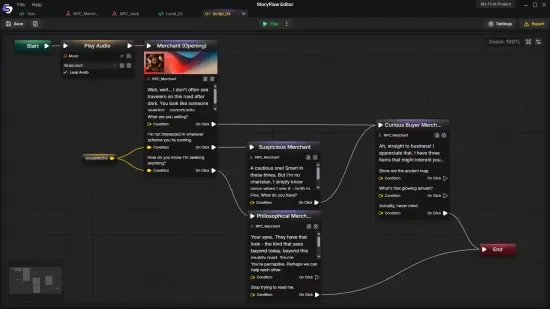
Soulstices StoryFlow Editor Portable is a revolutionary desktop application that democratizes interactive storytelling through an intuitive Blueprint-style visual scripting system, enabling writers, game developers, narrative designers, indie creators, and collaborative teams to craft intricate branching narratives, dialogue trees, choice-driven adventures, and dynamic story worlds without writing a single line of code.
Cross-platform for Windows (with macOS in active development), this Electron-based powerhouse—built with React, Tailwind CSS, and ReactFlow—transforms abstract plot ideas into playable prototypes via drag-and-drop nodes representing dialogue lines, player choices, conditional branches, variable states, script executions, and image assets, visualized in a zoomable canvas where connections illustrate narrative flow, allowing instant previews of any story path directly in-editor to test pacing, logic, and immersion before export.
Ideal for visual novels, RPG quest systems, interactive fiction, Twine alternatives, or Unreal/Unity narrative pipelines, StoryFlow Editor Portable handles projects of unlimited complexity—from simple choose-your-own-adventure books to multi-threaded epics with persistent player stats, inventory tracking, timed events, and randomized encounters—all organized via a professional Content Browser mimicking Unreal Engine’s asset management, complete with nested folders, favorites, drag-import, color-coding, Git integration for version control, and built-in validation to catch broken links or logic errors before runtime.
The editor’s core strength is its visual-first paradigm: open a project (.sfe file), spawn nodes (Dialogue, Choice, Condition, Variable Set/Get, Run Script, Image Display), wire them with Bézier curves labeled by outcomes, group into sub-graphs for modular scenes (e.g., “Tavern Encounter” macro), and hit Play to simulate as the player, jumping branches via hotkeys or clicks, with runtime supporting HTML5 Canvas for responsive web exports that embed images, styled text, sound cues (future), and mobile-friendly touch controls.
Visual Scripting Canvas
The heart of StoryFlow:
Node Library
-
Dialogue: Text bubble with speaker name, portrait image, typewriter effect.
-
Choice: 2-6 buttons; outcomes wire to branches.
-
Condition: If/else on variables (int/string/bool arrays), random rolls (1d20), flags.
-
Variable Ops: Set/Get/Modify (++, concat, math).
-
Flow Control: Jump/Loop/End; timers/delays.
-
Assets: Image viewer (PNG/JPG/GIF), future audio.
Multi-tab editing: Switch scenes without losing canvas state.
Canvas Tools
-
Pan/zoom (mouse wheel), lasso-select, auto-layout.
-
Node search/filter, color themes (black/green/blue).
-
Connection limits removed; self-loops for loops.
-
Context menus: Duplicate, delete, properties inline.
Project and Asset Management
Unreal-inspired workflow:
Content Browser
-
Hierarchical folders: Scripts/Scenes/Images/Variables.
-
Drag-import bulk files; thumbnails/previews.
-
Favorites/hotkeys; search/rename/validate.
-
Git hooks: Commit on save, branch per story arc.
Project System
-
New/Open/Switch; template starters (Linear, Branching, RPG).
-
Global variables (player_name, gold=100, quest_flags[]).
-
Export validation: Orphan nodes, undefined vars flagged.
Real-Time Testing and Runtime
In-Editor Play
-
Start from any node; simulate inputs.
-
Debug mode: Step/variable watch/branch tracer.
-
Fullscreen preview; responsive scaling.
Export Options
-
HTML5: Standalone web app (index.html + assets); browser/mobile.
-
JSON (upcoming): Data for Unity/Unreal/Godot import.
-
Zip bundle; relative paths for portability.
Runtime features: Typewriter text, choice hover effects, save/load states (localStorage).
Advanced Narrative Logic
Branching Mastery
Infinite paths: Condition nodes chain (if gold>50 and !quest_completed: “Rich path”).
Randomness: Roll d6 for encounters.
Modularity
Sub-graphs: “Combat Macro” reusable across quests.
Script nodes: Embed JS for complex (inventory sort).
State Persistence
Variables carry across sessions; array for inventories/flags.
Collaboration and Versioning
Git-native: .gitignore templates, diff previews for node changes.
Multi-user: Lock files prevent overwrites.
Roadmap Integrations
Future expansions:
-
AI Tools: Generate dialogue/images/voice via local LLMs.
-
UI Editor: Canvas for choice buttons/transitions.
-
Animations: Tween sprites/text.
-
Engine Plugins: Unity/Unreal/Godot importers.
-
Localization: Multi-lang JSONs.
-
Audio: SFX/voice import.
Performance and Tech Stack
Optimized for 1000+ node projects:
-
ReactFlow virtualization; 60fps canvas.
-
Electron 30.x; <500MB install.
-
Windows x64; macOS ARM/x86 soon.
Themes: Dark variants for long sessions.
Use Cases
Indie Devs: Prototype RPG dialogues pre-Unity.
Writers: CYOA books to HTML.
Teams: Shared quest design.
Educators: Teach logic visually.
Getting Started Workflow
-
New Project → Add Dialogue node → Text “You enter tavern”.
-
Add Choice: “Talk/Fight/Leave”.
-
Wire Fight → Condition (strength>10) → Win/Lose.
-
Play test → Export HTML.
Stop wrestling with spreadsheets. Start designing stories visually. StoryFlow Editor Portable is a visual node-based narrative design tool for creating branching dialogue systems, interactive stories, and complex game narratives. Built with a Blueprint-style visual scripting interface familiar to Unreal Engine developers – no coding required.