Portable Harmony Assistant 9.9.9i (x64)
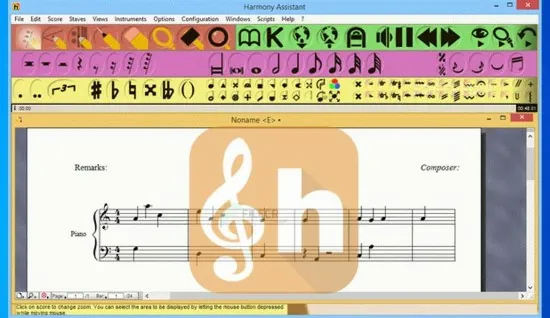
Harmony Assistant Portable is a sophisticated music notation and composition software that serves composers, arrangers, educators, performers, and hobbyists by providing a comprehensive platform for creating, editing, playing, and printing scores with professional-grade precision and sound quality. Developed by Myriad Software, this cross-platform application—available for Windows, macOS, and Linux—combines an intuitive score editor with embedded synthesis, automatic harmonization, tablature generation, digital audio recording, and scripting extensibility, enabling users to craft everything from simple melodies to full orchestral arrangements, karaoke tracks, or guitar tabs without requiring external hardware beyond a basic sound card. Its standout SoftSynth engine delivers realistic playback of complex notations including dynamics, articulations, and effects, while support for MIDI input, multi-track digital audio, and diverse export formats (MIDI, WAV, MP3, PDF, XML) makes it versatile for both creative workflows and collaborative sharing.
The software’s philosophy emphasizes musical intelligence: it doesn’t just draw notes but interprets them musically, rendering grace notes, trills, vibrato, and pedal marks with appropriate timing and expression. Whether entering music via mouse, keyboard shortcuts, MIDI controller, or scanning printed scores, Harmony Assistant Portable streamlines composition into an efficient, enjoyable process, rivaling dedicated DAWs in notation fidelity while surpassing them in score visualization and print quality.
Score Editing Interface and Input Methods
Harmony Assistant Portable’s workspace centers on a tabbed document view where scores unfold across unlimited staves, each assignable to instruments from a vast library covering orchestra sections, bands, choirs, world music (balalaika, erhu), and custom user-defined setups. The staff editor supports standard notation with key signatures, time signatures (simple, compound, irregular), clefs (treble, bass, alto, percussion), and tempo markings, all adjustable mid-score for evolving pieces.
Input flexibility defines usability: mouse drawing places notes/rests with drag-to-duration snapping; virtual piano roll or staff keyboard accelerates entry; MIDI real-time recording quantizes live performances with humanize options preserving feel. Computer keyboard maps to pitches (A‑G keys) or shortcuts (arrows for navigation, Ctrl+drag for copy). Step-time entry with chord input (Ctrl+notes for simultaneity) suits classical composers, while overlay staff mode layers harmonies atop melodies.
Multi-voice polyphony per staff handles piano parts or choral lines, with voice coloring distinguishing soprano/alto/tenor/bass. Lyrics attach syllabically, auto-syllabifying phrases and supporting multiple verses with karaoke timing. Gregorian notation mode employs square notes and modal scales for medieval chant.
Playback and SoftSynth Engine
Embedded SoftSynth—a high-fidelity software synthesizer—powers playback without external MIDI devices, utilizing SF2/SF3 soundfonts and hundreds of realistic instruments from Steinway grands to taiko drums. Multi-timbral architecture layers up to 128 voices polyphonically, rendering articulations (staccato/legato via note lengths), dynamics (ppp to fff via velocity curves), tremolo/vibrato (oscillation depth), and pedal (sustain/release).
Effects chain per instrument/staff: reverb (hall/room/plate), chorus, distortion, wah-wah, compressor, EQ, with MIDI CC mapping for live tweaks. Tempo variations, fermatas, caesuras, and ritardandos play expressively, while ottava/treble lines shift pitches accurately. Karaoke mode mutes voices selectively, syncing lyrics for rehearsals.
Digital tracks complement MIDI: record WAV/AIFF/MP3/OGG audio alongside notation, syncing via waveform view. Multi-take comping selects best segments; effects process (noise gate, pitch shift formant‑preserving, time stretch) refine recordings. Wav‑to‑note transcription converts audio to MIDI staves automatically.
Automatic Harmonization and Accompaniment
Harmony Assistant Portable’s intelligent harmonizer generates accompaniments from melodies: select style (classical, jazz, folk, rock), complexity (basic triads to full orchestrations), and it populates chord progressions, bass lines, and voicings matching harmony rules. Chord grids display above staves, editable manually or via library (1,000+ diagrams for guitar, ukulele, banjo). Auto‑chord recognition analyzes existing notes, suggesting symbols.
Drum patterns insert via grid editors, syncing rhythms to global tempo. Street organ roll printing simulates mechanical music boxes.
Tablature and Instrument Support
Tablature calculation spans fretted strings (guitar 6/7‑string, bass 4/5, banjo 5, balalaika, ukulele), harmonica (diatonic, chromatic), wind controllers, and lute theorbo. Standard notation converts bidirectionally to tabs, adjusting frets/tunings dynamically. Custom instruments define string counts, gauges, open tunings (DADGAD, drop D), and alternate notations (French tab, slash tab).
Wind instrument fingerings chart keys/valves; diatonic accordion buttons map bellows dynamics.
Effects and Notation Nuances
Notation sophistication includes slurs/ties, beams/groups, tremolo beams, arpeggio signs, repeats (D.S., D.C., coda), and measure repeats. Ornaments (trills, turns, mordents, acciaccatura) play with customizable speeds. Pedal marks sustain MIDI notes; glissando/portamento sweeps pitches smoothly.
Digital effects apply spatially: reverb tails, chorus flanging, distortion grit per staff. Multi‑band EQ sculpts tones; formant shifters vocalize instruments.
Import, Export, and Collaboration
Imports MIDI (standard/Rich/KAR), ABC, TAB/bTAB (Tabledit), MusicXML, MOD/S3M (module trackers), WAV/AIFF/MP3/OGG digital, scanned scores via OCR plugin. Exports mirror: MIDI with embedded lyrics, PDF (print/score viewer), WAV/MP3/OGG mixes, SVG graphics.
Myriad Plug‑in embeds interactive scores in websites—playable, transposable, printable. Virtual Singer integration sings lyrics in voices (solo/choir, languages).
Scripting and Extensibility
MyrScript language scripts custom behaviors: auto‑harmonizers, batch processors, plugin UIs. Debugger, editor, and 80+ stock scripts (drum grids, chord analyzers) extend functionality.
Cross‑Platform and Performance
Native Windows/macOS/Linux builds ensure fidelity; 64‑bit leverages multi‑core for playback/rendering. MIDI over USB/network, ASIO/low‑latency audio.
Educational and Performance Use
Choir modes manage vocal parts; lead sheets generate from full scores. Video tutorials onboard users.
Harmony Assistant Portable bridges notation and production seamlessly—composing symphonies or tabs with lifelike playback. Its harmonizer, tabs, SoftSynth, and scripts empower musical expression across genres, proving comprehensive tools democratize orchestration.