
Portable Audio Dedupe Professional 6.3.0.1 (x64)
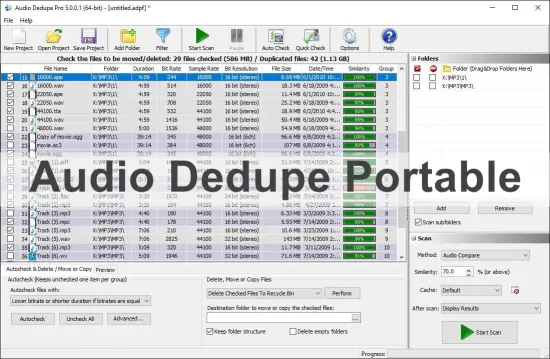
Audio Dedupe Portable is a sophisticated audio file management utility engineered to identify and eliminate duplicate and similar tracks within digital music collections through advanced acoustic fingerprinting technology rather than relying solely on file metadata or name matching. The application operates as a self-contained executable that requires no installation procedure, running directly from any directory location or removable storage device while maintaining complete containment of all configuration data, scan results, and operational parameters within its own file structure.
This portable architecture enables users to deploy the utility across multiple computing environments without leaving registry entries, system files, or configuration residues on host machines, making it particularly suitable for users who manage extensive music libraries across different systems, technicians performing library optimization on client machines, or privacy-conscious users who prefer software that does not integrate with the operating system beyond its execution lifetime. The core functionality transcends simple file comparison by actually analyzing the audio content itself, enabling detection of duplicate songs even when they exist in different file formats, bitrates, or with completely different filenames and metadata tags, providing a comprehensive solution for music collection cleanup that addresses the complex reality of how duplicate tracks accumulate in modern digital libraries.
Audio Fingerprinting Technology and Content Analysis
The foundation of Audio Dedupe Portable lies in its implementation of true audio fingerprinting technology, which represents a fundamentally different approach to duplicate detection compared to conventional file comparison methods. Traditional duplicate finders typically rely on file metadata such as ID3 tags, filenames, or file hashes to identify duplicates, but these approaches fail when the same song exists in different formats, with different tag information, or with varying filenames. Audio fingerprinting overcomes these limitations by analyzing the actual acoustic characteristics of the audio content, creating unique digital signatures based on the musical content itself rather than external descriptors. This content-based approach enables the software to recognize that two files contain the same song even when every external indicator suggests they are different pieces of content.
The fingerprinting algorithm examines multiple acoustic properties of audio files including frequency spectrum characteristics, temporal patterns, harmonic relationships, and other perceptual features that collectively create a unique signature for each distinct recording. This signature remains remarkably stable even when the audio undergoes common transformations such as format conversion, bitrate reduction, or normalization, enabling the software to identify duplicates across these variations. The algorithm is sophisticated enough to distinguish between genuinely different recordings of the same composition, such as studio versus live versions or different artists’ interpretations, while still recognizing identical recordings that have undergone minor processing or format changes.
Acoustic analysis operates at multiple levels of granularity to balance detection sensitivity with computational efficiency. Initial scanning performs rapid fingerprint generation and comparison to identify obvious duplicates, while subsequent analysis can examine more subtle acoustic similarities to detect near-duplicates that may represent different encodings of the same source material. This multi-stage approach enables the software to process large music collections efficiently while still providing thorough duplicate detection that catches subtle duplicates that might escape simpler detection methods. The fingerprinting process is designed to be robust against common audio file variations while remaining sensitive enough to distinguish genuinely different recordings.
Comprehensive Format Support and Cross-Format Detection
Audio Dedupe Portable supports an extensive range of audio file formats encompassing both legacy and contemporary codecs used in digital music collections. The application handles MP3 files in all common bitrate variants from low-quality compressed files to high-bitrate encodings, recognizing duplicates regardless of the specific encoding parameters used. This MP3 support extends to files encoded with different encoder software, different quality settings, or different MP3 standard versions, enabling detection of duplicates that may have been created through various encoding processes over time.
Lossless format support includes WAV, FLAC, AIFF, and other uncompressed or losslessly compressed formats commonly used by audiophiles and archivists who prioritize audio quality over storage efficiency. The software can identify duplicates between lossless formats and their compressed counterparts, recognizing when a FLAC file and an MP3 file contain the same underlying audio content despite their different storage formats and quality characteristics. This cross-format detection proves invaluable for users who have migrated their collections between formats over time or who maintain parallel collections in different formats for different usage scenarios.
Additional format support encompasses WMA, OGG Vorbis, M4A, AAC, and other formats used by various media players, online stores, and portable devices. This broad format compatibility ensures that the software can analyze heterogeneous music collections that have accumulated files from multiple sources over extended periods. Users who have purchased music from different online stores, ripped CDs using different software, or downloaded tracks from various sources will find that the software can identify duplicates across this format diversity, enabling comprehensive cleanup regardless of how the collection was assembled.
The software’s cross-format duplicate detection capability addresses a common scenario where users accumulate multiple versions of the same songs in different formats as they migrate between devices, players, or storage solutions over time. A song might exist as a high-bitrate MP3 ripped from a CD, a lower-quality AAC file purchased from an online store, and a FLAC file obtained from a high-quality download source. Audio Dedupe Portable can identify all these versions as duplicates of the same underlying recording, enabling users to make informed decisions about which version to retain based on their quality preferences, storage constraints, and compatibility requirements.
Similarity Detection and Near-Duplicate Identification
Beyond identifying exact duplicates, Audio Dedupe Portable excels at detecting similar audio files that represent near-duplicates with minor variations in encoding, processing, or source material. This capability addresses the reality that many duplicate tracks in music collections are not byte-for-byte identical but represent the same recording with subtle differences that may stem from different encoding settings, post-processing, or source quality. The similarity detection system employs configurable thresholds that allow users to specify how similar files must be to be considered duplicates, enabling fine-tuning of detection sensitivity based on individual requirements and collection characteristics.
The similarity algorithm can identify tracks that differ only in bitrate, recognizing when a 320 kbps MP3 and a 128 kbps MP3 contain the same audio content despite their different file sizes and quality characteristics. This capability proves valuable for users who have re-encoded portions of their collections at different times with different quality settings, or who have downloaded the same tracks from multiple sources offering different quality levels. The software presents these similar files together, enabling users to decide which version best suits their needs based on quality preferences and storage considerations.
Processing variations such as normalization, equalization, or volume adjustment do not prevent the software from recognizing underlying similarity between tracks. This robustness enables detection of duplicates even when one version has been processed to match the volume levels of other tracks in a collection or when different versions have been subjected to different audio processing chains. The similarity detection can also identify tracks that differ only in metadata or tag information while containing identical audio content, addressing scenarios where users have retagged files or obtained the same tracks from sources with different metadata conventions.
The near-duplicate detection capability extends to identifying different segments or excerpts of the same recording, such as when a full album track exists alongside a single version or radio edit of the same song. The software can recognize the acoustic relationship between these related files, presenting them together for user review and enabling informed decisions about which versions to retain. This sophisticated similarity detection transforms the software from a simple duplicate finder into a comprehensive tool for music collection analysis and optimization.
Metadata-Aware Analysis and Tag Handling
While Audio Dedupe Portable’s primary strength lies in its content-based fingerprinting that operates independently of file metadata, the software also incorporates comprehensive metadata analysis to provide additional context and organization for duplicate detection results. The application reads and displays ID3 tags and other metadata from supported audio formats, presenting users with complete information about each file including artist, album, track title, year, genre, and other descriptive fields. This metadata display complements the acoustic fingerprinting by providing human-readable context that helps users understand the relationships between detected duplicates.
The software handles cases where metadata is missing, incomplete, or inconsistent across duplicate files, relying on acoustic fingerprinting to identify duplicates even when tags provide no useful information or actively misleading information. This capability proves invaluable for users with collections containing files with poor or missing tag information, a common scenario with older files, files from various sources, or files that have been processed through multiple tagging applications over time. The fingerprinting technology ensures that duplicate detection remains accurate regardless of metadata quality, while the metadata display provides additional context when tag information is available and reliable.
Metadata comparison features enable users to identify not only acoustic duplicates but also files that share identical metadata while potentially containing different audio content. This reverse analysis can reveal cases where incorrect tagging has assigned the same metadata to different recordings, enabling users to identify and correct tagging errors in their collections. The software presents metadata alongside acoustic analysis results, allowing users to cross-reference tag information with audio content to ensure complete collection accuracy.
Tag editing capabilities integrated into the software enable users to correct or update metadata for files identified during duplicate scanning, providing a comprehensive solution for collection organization that addresses both duplicate removal and metadata quality improvement. Users can update tags for files they choose to retain, ensuring that their cleaned collection maintains accurate and consistent metadata that facilitates future organization and playback.
Flexible Scanning Configuration and Scope Control
Audio Dedupe Portable provides extensive configuration options for defining scan scope and parameters, enabling users to tailor duplicate detection to their specific collection organization and cleanup requirements. Users can specify individual folders, entire drive letters, or complex folder hierarchies for scanning, with options to include or exclude subdirectories based on collection structure and scanning objectives. This flexibility enables targeted scanning of specific collection portions that may be suspected of containing duplicates, or comprehensive scanning of entire libraries for thorough cleanup.
Scan depth and recursion options allow users to control how deeply the software traverses folder hierarchies, enabling shallow scans of top-level directories or deep recursive scans that examine every subfolder within specified paths. This control proves valuable for users with complex collection organization schemes where music files may be distributed across multiple nested directory levels, or for users who wish to limit scanning to specific organizational levels to avoid inadvertently scanning non-music directories that may contain audio files.
File type filtering enables users to specify which audio formats should be included in scanning, allowing exclusion of certain formats that may not be of interest or that may be known to be free of duplicates. This filtering can accelerate scanning by focusing processing resources on formats most likely to contain duplicates, or by excluding formats that users wish to preserve regardless of duplication status. Users can create custom filter configurations for different scanning scenarios, enabling rapid switching between different scanning profiles based on current cleanup objectives.
Performance optimization settings allow users to balance scanning thoroughness against processing time based on their priorities and available time资源。Users can configure fingerprinting sensitivity, similarity thresholds, and analysis depth to achieve desired detection accuracy while managing processing time requirements. These settings can be adjusted based on collection size, available processing time, and tolerance for false positives versus false negatives in duplicate detection.
Intelligent Results Presentation and Duplicate Grouping
Audio Dedupe Portable presents scanning results through an organized interface that groups detected duplicates together for efficient review and decision-making. The results display organizes files into duplicate groups, with each group containing all files identified as duplicates or near-duplicates of each other. Within each group, files are displayed with comprehensive information including file path, size, format, bitrate, and metadata, enabling users to make informed decisions about which version to retain and which to remove.
Visual indicators highlight key differences between duplicate files, such as format variations, bitrate differences, or file size disparities, helping users quickly identify the highest quality or most suitable version for retention. The interface can sort duplicate groups by various criteria including file quality, size, date, or path, enabling users to prioritize review based on their specific cleanup objectives. This organized presentation transforms what could be an overwhelming list of individual files into a manageable set of decision points, each representing a duplicate situation requiring resolution.
Preview functionality enables users to listen to audio files directly within the application, facilitating quality comparison between duplicate versions to inform retention decisions. This integrated playback capability allows users to assess subjective quality differences that may not be apparent from technical specifications alone, such as differences in encoding quality, dynamic range, or other perceptual characteristics that may influence which version provides the best listening experience. The preview feature supports common playback controls and can play selected portions of files for efficient quality comparison.
Duplicate group management tools enable users to mark entire groups for specific actions, such as retaining the highest quality version automatically or flagging all but one version for deletion. These bulk operations accelerate the cleanup process for large numbers of duplicates while still allowing user oversight and control over which files are affected. The software can apply consistent rules across all duplicate groups or allow group-by-group customization based on specific circumstances and user preferences.
Flexible Deletion Options and Safe File Management
Audio Dedupe Portable offers multiple approaches for handling files identified as duplicates, providing flexibility to match different risk tolerances and cleanup requirements. The safest option moves duplicate files to a designated folder rather than deleting them immediately, enabling users to verify that desired files have been retained and unwanted files correctly identified before permanent removal. This intermediate step provides a safety net against accidental deletion of wanted files, particularly valuable when processing large collections where manual verification of every decision may not be practical.
Standard deletion options move confirmed duplicates to the system Recycle Bin, providing an additional safety layer that enables file recovery if users later discover that deleted files were needed. This approach balances cleanup efficiency with data protection, allowing users to reclaim disk space immediately while maintaining the ability to recover files if necessary. The Recycle Bin approach is particularly suitable for users who prefer conservative cleanup strategies or who are processing collections where some uncertainty about duplicate status exists.
Permanent deletion options provide immediate space reclamation without intermediate steps, suitable for users confident in their duplicate identification and ready to commit to immediate cleanup. This option is appropriate when processing clear-cut duplicates where confidence in detection accuracy is high and disk space reclamation is a priority. The software confirms permanent deletion actions to prevent accidental data loss, requiring explicit user authorization before proceeding with irreversible file removal.
Deletion configuration options enable users to specify default handling for different duplicate scenarios, such as always retaining the highest bitrate version or preferring files in specific formats. These defaults accelerate the cleanup process by automating routine decisions while still allowing manual override for special cases or ambiguous situations. Users can create and save multiple deletion profiles for different cleanup scenarios, enabling rapid switching between different handling strategies based on collection characteristics and cleanup objectives.
Performance Optimization and Processing Efficiency
Audio Dedupe Portable is engineered for efficient processing of large music collections, implementing multiple optimization strategies to minimize scanning time while maintaining thorough duplicate detection. The software employs intelligent fingerprint caching that stores acoustic fingerprints for previously scanned files, enabling rapid re-scanning of collections without regenerating fingerprints for unchanged files. This caching significantly accelerates subsequent scans of the same collection, particularly valuable for users who perform periodic duplicate scanning to catch newly added duplicates.
Multi-threading support enables the software to utilize multiple CPU cores for parallel fingerprint generation and comparison, significantly accelerating processing on modern multi-core systems. This parallelization is particularly effective for large collections where many files can be processed simultaneously without resource contention. The software automatically adjusts its threading configuration based on detected system capabilities, maximizing performance across diverse hardware configurations from single-core legacy systems to high-end modern workstations.
Memory management strategies enable efficient processing of extensive collections without excessive RAM consumption, using streaming approaches that process files sequentially rather than loading entire collections into memory. This approach enables processing of collections larger than available system memory, with temporary storage of intermediate results to disk as needed. The streaming architecture also provides natural checkpointing that enables scan resumption after interruptions without losing progress, particularly valuable for very large collections that may require extended processing time.
Optimization settings allow users to balance processing speed against detection thoroughness based on their priorities and time constraints. Users can configure fingerprinting algorithms for faster processing with slightly reduced sensitivity, or for maximum thoroughness with longer processing times. These settings can be adjusted based on collection size, available processing time, and tolerance for potential false negatives in duplicate detection.
Portability Architecture and System Independence
The portable design of Audio Dedupe Portable extends beyond simple execution without installation to encompass comprehensive self-containment of all operational requirements within the software’s directory structure. All configuration files, fingerprint databases, scan results, and user preferences are stored within the application directory, ensuring complete mobility between computing environments. Users can copy the entire application directory to removable media or alternative locations while preserving all settings, historical scan results, and customized configurations, enabling immediate resumption of work in new environments without reconfiguration or data loss.
System integration is minimized to only what is necessary for audio file access and processing, with the software making no registry modifications, installing no system services, and creating no files outside its own directory. This minimal integration approach ensures that the software leaves no trace on host systems beyond the executable and its associated files, supporting use in shared computing environments, restricted corporate systems, or any scenario where system cleanliness and minimal footprint are priorities. The software can be completely removed by deleting its directory, with no residual files or configuration requiring cleanup.
License management in the portable version operates without requiring online activation or persistent internet connectivity, enabling use in offline or air-gapped environments where necessary. License files can be transferred between systems along with the application directory, maintaining full functionality across different workstations without requiring re-activation or online verification. This approach respects user privacy and provides maximum flexibility for deployment scenarios ranging from personal use to enterprise distribution across multiple computers.
Batch Processing and Automation Capabilities
Audio Dedupe Portable supports extensive batch processing capabilities that enable automated handling of large numbers of duplicate files according to user-defined rules and preferences. Users can configure batch operations to automatically retain specific file types, quality levels, or paths while marking all other duplicates for removal, enabling largely automated cleanup of straightforward duplicate scenarios. This automation proves invaluable for processing large collections where manual review of every duplicate would be impractical.
Scheduled scanning capabilities enable users to configure automatic periodic scanning of specified directories, ensuring that duplicate detection remains current as new files are added to collections. These scheduled scans can operate with minimal user intervention, automatically identifying new duplicates and applying user-defined handling rules to maintain collection cleanliness over time. The scheduling system can be configured to run scans during off-peak hours to minimize impact on system performance during active use.
Command-line interface support enables script-based automation and integration with larger collection management workflows, particularly valuable for users who maintain extensive automated music processing pipelines. The command-line interface supports specification of scan paths, output formats, and handling rules, enabling complete control over duplicate detection and cleanup without requiring manual interface interaction. This automation capability proves essential for enterprise deployments or users managing multiple collections across different systems.
Conclusion
Audio Dedupe Portable represents a comprehensive, professional-grade solution for music collection deduplication that combines sophisticated acoustic fingerprinting technology with practical usability and flexible configuration options. The software’s ability to identify duplicates across different file formats, bitrates, and metadata configurations addresses the complex reality of how duplicate tracks accumulate in modern digital music libraries, while its similarity detection capabilities enable identification of near-duplicates that represent the same recording with minor variations. The portable architecture supports deployment flexibility and system cleanliness while the comprehensive format support ensures compatibility with diverse music collections assembled from multiple sources over extended periods. Advanced features such as batch processing, automation capabilities, and extensive configuration options provide depth for power users and large collection managers while the intuitive interface and clear results presentation make the software accessible to users with varying technical backgrounds. For anyone seeking to optimize their music collection through informed duplicate removal, Audio Dedupe Portable provides the analytical capabilities, processing efficiency, and flexible handling options necessary to achieve meaningful collection cleanup and disk space reclamation through evidence-based duplicate identification and removal.
Features at a Glance
- True audio fingerprinting technology for content-based duplicate detection
- Acoustic analysis independent of file metadata, filenames, and ID3 tags
- Cross-format duplicate detection across MP3, WAV, FLAC, OGG, WMA, M4A, AAC, AIFF, and more
- Near-duplicate identification for files with similar audio content but different bitrates or encoding
- Configurable similarity thresholds for fine-tuning detection sensitivity
- Detection of duplicates across different encoders, quality settings, and MP3 standard versions
- Robust fingerprinting resilient to format conversion, bitrate reduction, and normalization
- Multi-stage analysis balancing detection sensitivity with computational efficiency
- Comprehensive metadata reading and display for ID3 tags and other file information
- Duplicate detection even with missing, incomplete, or inconsistent metadata
- Metadata comparison to identify incorrectly tagged files with identical tags but different audio
- Integrated tag editing capabilities for correcting or updating file metadata
- Flexible scanning scope with individual folders, drive letters, or complex hierarchies
- Configurable scan depth and recursion options for shallow or deep directory traversal
- File type filtering to include or exclude specific audio formats from scanning
- Performance optimization settings to balance thoroughness against processing time
- Organized results presentation with duplicate grouping for efficient review
- Visual indicators highlighting format, bitrate, and file size differences between duplicates
- Sorting options by quality, size, date, path, or other criteria
- Integrated audio preview with playback controls for quality comparison
- Duplicate group management with bulk selection and action application
- Multiple deletion options including move to folder, Recycle Bin, or permanent deletion
- Safety features with intermediate steps and confirmation prompts to prevent accidental data loss
- Configurable default handling rules for different duplicate scenarios
- Intelligent fingerprint caching for rapid re-scanning of previously processed collections
- Multi-threading support for parallel processing on multi-core systems
- Efficient memory management enabling processing of collections larger than available RAM
- Checkpoint and resumption capability for interrupted scans
- Complete portable architecture with all data contained within application directory
- No registry modifications, system services, or files outside application directory
- Offline functionality without online activation or license verification requirements
- Batch processing capabilities for automated handling of large numbers of duplicates
- Scheduled scanning for automatic periodic duplicate detection
- Command-line interface support for script-based automation and integration
- Custom deletion profiles for different cleanup scenarios
- Detection of different segments or excerpts of the same recording such as album tracks versus radio edits
- Distinguishes between genuinely different recordings of the same composition like studio versus live versions
- Support for heterogeneous collections with files from multiple sources and time periods
- Automatic adjustment of threading configuration based on detected system capabilities
Release Notes:
- Added: Improved duplicate detection algorithm. Detects up to 10-30% more duplicate songs.
(Delete old cache and create a new one to benefit from the improved algorithm.) - Added: Better stability.
- Added: Usability improvements and UI fixes.