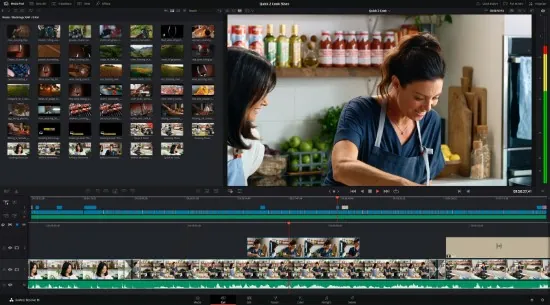
Portable DaVinci Resolve Studio v21.1.0.14 Multilingual

DaVinci Resolve Portable is the world’s only solution that combines professional 8K editing, color correction, visual effects and audio post production all in one software tool! You can instantly move between editing, color, effects, and audio with a single click. DaVinci Resolve Studio is also the only solution designed for multi user collaboration so editors, assistants, colorists, VFX artists and sound designers can all work live on the same project at the same time! Whether you’re an individual artist, or part of a large collaborative team, it’s easy to see why DaVinci Resolve is the standard for high end post production and finishing on more Hollywood feature films, television shows and commercials than any other software.
What’s New:
DaVinci Resolve Portable features a revolutionary new cut page specifically designed for editors that need to work quickly and on tight deadlines! The new DaVinci Neural Engine uses machine learning to enable powerful new features such as facial recognition, speed warp and more. Adjustment clips let you apply effects and grades to clips on the timeline below, quick export can be used to upload projects to YouTube and Vimeo from anywhere in the application, and new GPU accelerated scopes provide more technical monitoring options than before. Plus, Fusion is dramatically faster and Fairlight adds immersive 3D audio. DaVinci Resolve Portable is a massive release with hundreds of features customers have asked for!
Introducing the Cut Page!
Designed specifically for editors working on high end fast turn around work such as television commercials and even news cutting, the cut page is all about speed. It’s an alternate edit page with a streamlined interface and revolutionary new tools that will help you work faster than ever. The cut page lets you import, edit, trim, add transitions, titles, automatically match color, mix audio and more. Whether you’re delivering for broadcast or for YouTube, the cut page has everything you need to get the job done, all in one place. Plus, the regular edit page is still available so you can switch between edit and cut pages to change editing style right in the middle of a job.
Improvements to speed editor functionality on the edit page
In the edit page, the speed editor features a number of workflow improvements. The Sync Bin button opens the source viewer in multicam mode. The CAM buttons switch angles in multicam clips and timelines. Audio level, trim in, trim out and other functions prioritize selection followed by track order. The slip source button always works on the clip under the playhead and slip dest works on the following clip. Other speed editor functions now match the behavior on the Cut page.
Multiple subtitle improvements
You can now override individual properties for each subtitle caption, e.g adjust font family and style while keeping font size and background to follow track. Imported HTML styled rich text in SRT is handled better with subsequent font changes.
You can also specify per-track deliverable rules, setting multiple tracks targeted at specific markets, each with their own custom CPS, timing and line rules.
Both track style and rules can be saved and recalled as presets from the inspector 3 dot option menu.
New tracks are now added in context in the edit timeline
Context clicking and adding a track inserts the new track adjacent to the context clicked track. When adding multiple tracks, the dialog suggests the appropriate position for the new tracks.
Media inputs for Fusion effects in the edit inspector
You can now drag and drop media pool clips to the inspector as Fusion inputs. When creating Fusion effects, plugins and transitions, you can create media drop targets by selecting a Media In tool and exporting clip name as an inspector control.
Combined sizing and alpha support for nested compound clips
Multicams and simple compound clips can now combine sizing and alpha changes from their child clips with sizing and alpha changes applied in the parent timeline, effectively preserving the underlying media resolution.
New Resolve FX Sky Replacement including generated sky textures
Resolve FX Sky Replacement allows for keying and replacing the sky in shots with B-roll or artificially generated sky textures. You can use it to keep the sky consistent between takes or provide more appropriate backgrounds to creatively affect color and mood.
An option to review rendered clip before social media upload
From the render queue 3 dot option menu, you can enable Review Before Upload. When rendered, jobs with internet presets render to disk and show that they’re waiting for upload. From the job’s context menu, you can reveal the rendered file, review the quality and content and upload the result.
Individual timeline locks in multi-user collaboration projects
With DaVinci Resolve 18.1, you can lock and edit individual timelines without locking the parent bin’s contents. This allows for greater flexibility in multi-user projects in setting up your media pool bins without locking other media or timelines in the same folder.
You can still manually choose to lock individual media pool bins to secure their contents independently.
Reorganized and streamlined view menu
The View menu has been streamlined and improved to make it easier to focus on View-related choices that apply to the entire application, while moving some view-oriented choices that are specific to a single page (e.g., Color) to local menus.
The View menu has been reduced from 40+ items to 25. Some items have been moved into a hierarchical choice, and some moved elsewhere to panel-specific context menus.
- The Color Page viewer’s 3 dot option menu now includes options like Window Outline, Highlight, Wipe and Split Screen, aggregating some items that were formerly hidden in context menus. These can now be controlled via the keyboard if desired.
- Stills options and Step Timeline Wipe are now available from the Color menu.
- Display of Smart Bins and Power Bins are now available in the Media Pool panel options menu as they are local to the Media Pool.
- Playhead shadows, Gray viewer backgrounds and 2D timeline scrolling can now be found in Preferences>User Preferences.
Dolby Vision cinema trims
DaVinci Resolve now supports the Dolby Vision XML 5.1.0 format which includes trim support for Dolby Vision cinema targets as well as L11 metadata. Users can create trims for Home and Cinema targets by selecting the appropriate target displays.
When exporting a 5.1.0 XML from a Dolby Vision version 4.0 project, there is a dialog where the mastering colorspace, application type and L11 values for content type and intended white point can be chosen.
Fairlight automation curves updates
Substantial update to audio automation curves, including vector-based keyframing, ability to graphically enter, edit, trim, nudge keyframes with standard tools.
- A new automation editing view, selectable from the track header automation drop-down menu, allowing management of curves and keyframes. You can add (Option/Alt-click), remove (Ctrl-Alt/Cmd-Option-click), select and move individual keyframes, or select, edit or cut/copy/ paste keyframe ranges. A keyboard shortcut can be configured to allow you to easily switch to fader views.
- Automation curve data written by control surfaces now appear as keyframes on the curve line.
- Moving keyframes now creates smooth ramps between any 2 adjacent points. When moving multiple keyframes in a range, bounding keyframes are automatically added to the range to preserve values outside the range.
- Select an area and drag up or down to create “carve out trims,” allowing instant level changes over a selected area. Use the Shift key for fine tuning.
- In the multi tool focus mode, hold shift-alt/shift-option to temporarily switch to the pencil tool to redraw curves.
- An overlay will appear when trimming and adjusting keyframes. e.g. “-8.5 dB (∆1.3 dB)” indicating absolute level value (-8.5 dBfs) and the change in the current trim operation (+1.3 dB).
- The Select Range Mode Tool is now removed as it is no longer needed. The other tools (especially Multi Tool in Focus mode) can now be used in the Automation curve view to select and manipulate keyframing.
Fairlight automation modes updates
New behaviors have been added to automation modes:
- Automation values now update when moving the playhead to a new location, avoiding discontinuities when recording automation; faders are always up to date when the Playhead is parked.
- The Fairlight>Automation menu has several new choices:
- You can choose Write to Start/End/All actions to write current automation levels to the start, the end or all of your timeline.
- Choose Join to manually resume writing automation in Latch mode from the current level.
- You can set an automation active zone (indicated in red on the ruler) by choosing Fairlight>Automation>Active Range and choosing In, Out or Enable to restrict where automation can be written. Automation preview switches automatically at the borders, allowing playback before and after the active range and recording within the range.
- Trimming can be initiated by touching and holding the fader prior to pressing play, or prior to or during playback, pressing the automation punch button on the channel. The button will turn red and the fader cap will turn yellow. Use of the punch button allows trimming to be initiated on some channels and not on others.
- You can disable per-track automation recording and automation playback by right clicking the automation arm icon in the mixer and selecting Off or Safe.
- The user preference “Include mixer events in the undo stack”, in the Fairlight tab, allows mixer actions to be undone from Edit>Undo (Control/Cmd-Z).
Fairlight grid mode
The Fairlight grid mode allows you to position clips on a grid based on timecode or musical tempo.
- From the Grid options, located next to the Timeline View options above the ruler, you can customize grid line visibility, duration, snapping to grid lines and other options.
- For the timecode grid, you can select resolutions of 1 second, 1 frame, 1/2 frame and 1/4 frame.
- For the tempo grid, you can configure beats per minute, note duration (1 bar, 1/2 note, 1/4 note, 1/8 note, 1/16 note) and time signature (4/4, 3/4 and 6/8).
- The ruler context menu also allows you to set grid start at a timecode location, or create grids from a range. Areas before the grid start are shown with negative bar|beat values. You can set a grid from a selected time range and set the start point and number of measures so that tempo is automatically calculated.
- Musical tempo grid lines are labeled with bars, beats and note durations. A counter location of “003|03|09” indicates a grid location of “bar 3, beat 3, and nine 16th notes.”
Voice isolation processing
The Fairlight page now has a new DaVinci Neural Engine AI-based core effects process that appears in the Inspector or as a floating plug-in window. This processing can remove loud, undesirable sounds from existing voice recordings. You could literally remove a jackhammer from a recording, leaving only the voice. Voice isolation can be very effectively for general purpose noise or room sound reduction/removal – including air conditioning, traffic, generator or motor noise, echoes and reverbs, undesired room sound, and other background sounds.
The voice isolation effect is one of two Fairlight track effects (the other being the dialogue leveler), accessible from the inspector. Under the audio tab, you can enable voice isolation for selected mono and stereo clips and tracks in the Fairlight, edit and cut pages. For tracks, it can also be enabled from the track FX section in the Fairlight mixer.
- There are two controls: effect on/off and an “Amount” control (0-100%). Using just a bit less than 100% can create a more natural result.
- Supported as an effect in mono and stereo tracks and clips.
- Live audio input cannot be used; the sound source must be on disk.
- Note: Voice isolation is not suitable for anything other than the human voice, and primarily useful for dialogue processing.
Fairlight FX Dialogue leveler
The dialogue leveler allows for very useful improvements to dialogue recordings without the need for tedious level adjustment (clip gain or automation curves) or the artifacts of compression or expansion.
Use the dialogue leveler for dialogue recordings that are partially off mic, or have multiple people in a scene at different volumes, differing levels are too extreme, etc, to get extremely even and natural results, while maintaining the perspective of the original balance. The overall effect allows dialogue levels that originally jump out or are near inaudible to sit well in the final mix.
The dialogue leveler (like the voice isolation effect) can be enabled from the inspector and the track FX section in the Fairlight mixer.
The dialogue leveler’s controls include:
- An on/off switch.
- 4 presets optimized for different dialogue types. The default (“Optimize most sources”) works for most material.
- 3 module switches that allow to further tailor the response to your source material.
- An output level control with up to 6 dB of gain.
What’s new in DaVinci Resolve Portable 21
DaVinci Resolve Studio 21 Portable introduces a major round of new features that push the software beyond its traditional strengths in editing, color, audio, and finishing. This version brings a wider creative range, a stronger AI-assisted workflow, and a deeper integration of still-image and motion-picture tools into one environment. For users who want a detailed look at what is new, the biggest changes can be grouped into photo editing, AI tools, editing improvements, Fusion updates, Fairlight enhancements, and workflow refinements across the application.
The Portable wording in this draft is used as requested, even though the software itself is normally known as a full-featured studio application. In practice, the new feature set is what matters most here, because DaVinci Resolve Studio 21 is one of the most expansive updates the platform has received. The release is not just an incremental refresh. It adds whole new workflows and expands the software into areas that were previously handled elsewhere in the post-production process.
Photo Page
One of the headline additions in DaVinci Resolve Studio 21 Portable is the new Photo page. This is a major expansion because it brings advanced still-image work directly into the Resolve ecosystem. The Photo page lets users move between image grading, photo correction, and the broader video pipeline without leaving the same application, which creates a more unified creative environment.
The new page supports advanced color tools for still images, making it possible to work with primary corrections, curves, qualifiers, power windows, and node-based grades. That means photographers and colorists can build a consistent look for individual images or entire sets while using familiar Resolve-style grading concepts. The Photo page also introduces a workflow where shared nodes can be used to apply a consistent grade across multiple images, which is especially useful for album-style projects.
Another important addition is the LightBox-style view for album navigation. This lets users see a wider overview of their graded stills and observe how edits change in real time. The result is a more album-aware workflow that feels organized and visual rather than file-by-file and isolated. For anyone who wants to bring still-image editing closer to a professional color pipeline, this is one of the most meaningful changes in the update.
Tethered camera controls
DaVinci Resolve Studio 21 Portable also adds new Camera Controls for direct tethering with supported cameras. This is useful for users who want to capture stills directly into the application while keeping an eye on exposure, ISO, white balance, and other key capture settings. The idea is to let photographers and image professionals work more fluidly before, during, and after a shoot.
The camera workflow is designed to support live view, capture presets, and consistent image preparation. That makes it possible to lock in a preferred look before the session begins and then maintain that look as shots are captured. Images can be saved directly into an album, which keeps the session organized and helps the user transition quickly from capture to review. This is a practical addition for users who want Resolve to play a more active role in still-image production.
AI search and media organization
One of the strongest themes in DaVinci Resolve Studio 21 Portable is the introduction of new AI tools that make media handling faster and more intelligent. A standout addition is IntelliSearch, which allows users to search the media pool using natural language or content-based keywords. That means users can find clips by looking for faces, objects, or dialog-related references instead of relying only on manual sorting and naming.
This kind of search changes the feeling of working in large projects. In a substantial timeline or a big media library, finding the right shot can take time if the project is poorly organized. IntelliSearch helps shorten that process by turning the search itself into a more intelligent assistant. For editors and assistants handling large volumes of footage, this can significantly improve daily efficiency.
Facial AI tools
Several new AI features in Resolve 21 focus on faces and facial detail. Face Age Transformer can change the apparent age of a tracked subject, while Face Reshaper lets users adjust the shape and position of facial features. These are clearly advanced tools, and they expand the software’s ability to support high-end finishing workflows that involve tracked subjects.
There is also Blemish Removal, which assists with skin retouching. This gives users a more direct way to smooth minor imperfections while preserving a natural look. Together, these tools show that DaVinci Resolve Studio 21 Portable is aiming to provide more intelligent and more refined portrait and character adjustment capabilities than before. That is valuable in both editorial and creative work where subtle facial treatment matters.
Focus and depth tools
CineFocus is another major addition in the AI toolset. It allows users to adjust synthetic depth of field and create keyframeable rack focus effects. This is useful when a shot needs more visual emphasis on a subject or when a focus shift needs to be adjusted after the fact. Rather than treating focus as a fixed element of the footage, the new tool gives editors and finishing artists more room to shape the visual attention of a scene.
The significance of this feature is that it extends the manipulative power of the software into the perception of depth itself. By allowing focus and blur to be treated with more control, Resolve gives creators another layer of finishing flexibility. In practical terms, that means more opportunities to fix, refine, or emphasize shots without starting over.
Speech generation
AI Speech Generator is one of the most notable new workflow additions in DaVinci Resolve Studio 21 Portable. It creates voiceovers from text using a custom voice model that can be built from a very small amount of source audio. This adds a new dimension to voice production inside the post-production environment and can help with temporary narration, scratch audio, or even final delivery in some cases.
The importance of this feature is not only that it can synthesize speech, but that it integrates audio creation into the broader post workflow. Instead of exporting text to an external tool and then bringing audio back in, users can work more fluidly within the same application. That is a strong productivity advantage for projects that need frequent voice changes, placeholders, or rapid audio iteration.
Slate reading and metadata
Another intelligent feature added in version 21 is Slate ID, which can read and extract information from clapperboard-style metadata. This is especially useful in organized production environments where scene and take information matter. Being able to capture that information automatically can save time and reduce manual entry.
When metadata is handled efficiently, post-production becomes smoother because clips can be identified faster and tracked more accurately. Slate ID adds a layer of automation that helps connect on-set information with the editorial process. For users managing larger productions, that can improve consistency and reduce friction when moving material into the project.
Motion cleanup
Motion Deblur is another helpful addition in the AI feature set. It is designed to reduce motion blur artifacts and improve the clarity of footage where movement caused unwanted softness. That can be extremely useful when a shot is important but not perfectly sharp, especially if reshooting is impossible or costly.
This feature reflects a broader goal of Resolve 21: giving users more ways to rescue and improve footage after acquisition. Instead of accepting blur as a permanent problem, the software offers a way to reduce its impact. That kind of recovery tool is valuable in real-world production because not every shot is ideal, and finishing often involves making imperfect material usable.
Cut and Edit improvements
DaVinci Resolve Studio 21 Portable adds meaningful improvements to the Cut and Edit pages as well. Keyframing has been expanded with new easing modes such as loop, pingpong, and relative behaviors, along with more flexible animation control. This makes timing adjustments and motion work easier to shape in a more expressive way.
There is also support for simultaneous multi-clip adjustment and four-point Bezier easing for video retiming. These refinements improve the way editors manipulate timing and animation across clips. The practical result is smoother motion control and a more precise editing experience, especially for projects that need carefully shaped timing transitions.
Fusion updates
Fusion receives several important enhancements in Resolve 21. One of the major changes is Krokodove integration, which adds a large number of compositing and graphics tools directly into the software. This widens the creative possibilities for motion graphics, effects work, and advanced compositing tasks inside the same application.
Another useful improvement is the ability to adjust Fusion effects more directly from the keyframes and curves editors in the Cut and Edit pages. That makes the workflow feel more connected, because the user can handle more effect-related work without constantly jumping into separate areas of the interface. The update also introduces layer list node graphs, which can make complex compositing relationships easier to understand and manage.
Fairlight improvements
Fairlight also sees meaningful development in this release. The new folder tracks feature allows multiple audio tracks to be collapsed into a composite view, which helps make large sound projects easier to navigate. That is a practical upgrade because many audio sessions become difficult to follow once they grow in size, and better organization can save a lot of time.
The audio side of the software benefits from this cleaner structure, especially in sessions with many dialogue, music, and effects layers. Folder tracks reduce visual clutter while preserving access to the underlying material. That makes the audio workspace more efficient and less overwhelming during detailed mixing or post-production work.
Graphics and web content
DaVinci Resolve Studio 21 Portable also expands support for modern graphics workflows. Native support for OGraf HTML graphics and Lottie animations adds more flexibility for users who work with motion graphics and interactive-style elements. Drag-and-drop support for .json and .lottie files makes it easier to bring those assets into a project.
This is important because modern post-production often includes more than traditional clips and titles. Graphics systems are becoming more web-like and animation-aware, and Resolve 21 is responding by supporting those formats more directly. That gives creators more room to mix design, motion, and editorial work in one project.
Deliverables and mastering
Another powerful feature in Resolve 21 is MultiMaster trim passes for generating multiple HDR and SDR deliverables from a single timeline. This is a major workflow advantage for projects that need several output versions without rebuilding the entire edit separately. It helps streamline finishing for deliverables that must exist in different brightness or color-intensity standards.
That kind of feature is especially useful in modern distribution pipelines where one edit may need to serve several formats. Instead of duplicating effort, users can work from a common timeline and produce tailored outputs more efficiently. This keeps the mastering process cleaner and more consistent.
Immersive and advanced pipeline support
The update also includes improvements to the broader technical pipeline, including an updated USD SDK and support for Apple Immersive foveated rendering. These additions show that Resolve 21 is not only aiming at conventional editing work but also at advanced media formats and immersive workflows. That broadens the software’s relevance for users working at the edge of current production trends.
Updates like these matter because post-production is no longer limited to one type of output. Projects may involve traditional video, immersive experiences, graphics-rich content, or mixed-format deliverables. By updating these underlying systems, Resolve strengthens its position as a multi-purpose production platform rather than a narrow editor.
Picture in Picture and timeline tools
New Picture in Picture Resolve FX support adds another useful visual tool to the mix. This helps creators build layered presentation styles and more dynamic compositions inside the software. It is a practical addition because picture-in-picture layouts are common in educational, social, and presentation-oriented content.
These timeline-related features fit into the broader pattern of Resolve 21, which is about making the software more capable in everyday editing while also expanding into specialized workflows. The result is a more versatile toolset that can support both quick production tasks and more advanced finishing needs.
Overall scope
The overall scope of DaVinci Resolve Studio 21 Portable is large enough that it feels like a substantial evolution rather than a simple point upgrade. The addition of the Photo page alone expands the software into still-image work in a serious way. The AI tools then push the platform deeper into intelligent search, facial analysis, image refinement, and speech generation. Meanwhile, the editing, Fusion, Fairlight, and delivery updates strengthen the rest of the pipeline so the software remains a unified production environment.
For users who want a detailed summary of what is new, the most important takeaway is that version 21 is built around integration and automation. It brings more of the creative process into a single application and gives users more ways to handle complex work faster. That combination makes it one of the most ambitious updates in the software’s history.
In practical terms, DaVinci Resolve Studio 21 Portable gives editors, colorists, audio professionals, and content creators more tools, more intelligence, and more flexibility. It expands Resolve’s reach across still images, AI enhancement, metadata handling, motion graphics, audio organization, and mastering. The result is a much broader and more capable post-production environment for users who want to work across the full creative chain.
Minimum System Requirements for Windows
- Windows 10 Creators Update.
- 16 GB of system memory or 32 GB when using Fusion.
- For monitoring, Blackmagic Design Desktop Video 12.9 or later.
- Integrated GPU or discrete GPU with at least 4 GB of VRAM.
- At least 16 GB VRAM for advanced AI tools.
- At least 32 GB RAM and 12 GB VRAM for background rendering.
- GPU which supports OpenCL 1.2 or CUDA 12.8.
- AMD/Intel official drivers from your GPU manufacturer.
- NVIDIA Studio driver 581.57 or newer.
Release Notes:
The following features have been added or updated.
Media Page
- Media pool list view text and checkbox fields can now be edited.
- Search includes sub bins and supports exact text matching.
- AI tools preference to use proxy media if originals are offline.
- Original aspect ratio in source viewer with no external monitoring.
- Source viewer supports interlaced media previews.
- Preview geometry assets from media pool and media storage.
- Rename faces in the IntelliSearch Manage Faces window.
- Ability to change starting timecode for multiple selected clips.
- Ability to delete selected markers in media pool list view.
- Created/modified dates for multicams, compound clips and timelines.
- Delete multiple audio tracks in clip attributes using mouse drag.
- Import Canon EOS VR clips in VR180 workflows.
- Stereoscopic 3D clip attributes support swapping eyes.
- Side by side clip attribute for BRAW, JPEG, PNG and TIFF.
- Assign custom Apple Immersive ILPDs to OpenEXR sequences.
- Assign key shortcuts to show or hide media pool bin view.
Photo Page
- Camera control support for Fujifilm cameras.
- Camera control support for Leica cameras.
- Camera control support for Sony Alpha 7R VI.
- Change image settings in inspector using color panels.
- Improved post decode sharpening for RAW images.
- Improved sidebar with flexible height and stacked panels.
- Inspector reset controls for each RAW parameter.
- DNG file support for lens distortion, aberration and shading.
- Resolve FX Sky Replacement support for album photos.
- Assign key shortcuts to toggle capture live view.
Cut and Edit Pages
- Support for inspector presets.
- Multicam editing mode is now a timeline viewer property.
- Option to split multicams at gaps when using timecode sync.
- Switching multicam grid size retains page with selected angle.
- Multicam key shortcuts now work with timeline or source focus.
- Assign key shortcuts to decompose multicams.
- Assign key shortcuts to switch or cut up to 25 multicam angles.
- Assign key shortcuts for source and auto select for up to 32 tracks.
- Edit Fusion properties for multiple selected clips in inspector.
- All new compare timeline workflow with greater control.
- Data Burn can show clip metadata from a specified video track.
- Presentation markers support annotations, replies and status.
- Marker annotation support for drawing ellipses.
- Zoom audio waveform actions in the edit timeline.
- Playhead indicator for current clip in inspector and viewer.
- Clip selections are now cleared when setting timeline in or out.
- Improved edit page trim editor with mouse drag and nudge.
- Refine dynamic trim edit point selections with auto select.
- Switching to dynamic trim enables trim mode by default.
- Dynamic trim editor loop playback continues when editing.
- Ability to cut, copy and paste gaps on the edit timeline.
- Timeline view option to automatically scale audio waveforms.
- Timeline view option to display clip durations.
- Two Cut page timer options for source tape and multiview.
- Ability to apply transitions to adjustment clips.
- Export marker list from edit index as a PDF.
- Option shift dragging clips preserves existing transitions.
- Restored timeline backups retain backup history.
- Preference option to stop playback when scrubbing.
- Preference option to always play audio on playhead move.
- Preference option to select clip after playhead on blade.
- Inspector now honors auto track selection for displayed clip.
- Improved shift-click clip selection across tracks in edit page.
- Clear solo and restore solo support in the edit page.
- Fusion color picker support in edit and cut page viewers.
- Font browser option to display text preview from title.
- AI music editor retains more content, avoids repetition.
- AI music editor offers better mix choices on analysis.
- Select gap space after last clip on track for trim edits.
- Replay ability to enter input view directly from run mode.
Fusion Page
- New Krokodove based shape and 3D tools.
- Support for OpenPBR material shaders.
- Improved MultiText layer align behavior.
- Calibrate lens distort from user drawn lines on viewer.
- Animation action support for OGraf clips on timeline.
- Support for frame, ease and scale controls in OgrafLoader.
- Macro Editor supports load and save of multi-template DRFX files.
- Improved Macro Editor batch select, grouping and organization.
- Macro Editor update macro action adds tools from node selection.
- Fairlight Animator now has adjustable low and high pass filters.
- Ability to import externally tracked results to Camera Tracker.
- Tracker controls to trim tracks, view and change reference frame.
- Support for flipbook previews for Fusion deep image toolset.
- Support for hard mix blend mode for Fusion tools and PSD import.
- Support for matte objects for Renderer3D in deep mode.
- Pre-divide and post-multiply alpha handling in log conversion tools.
- Support for deep motion blur for Renderer3D.
- Up to 8x faster hardware accelerated 3D deep renders.
- Improved Desktop Video monitoring performance.
- Enhanced variable syntax for use in evaluations or substitutions.
Color Page
- Individual MultiMaster trim for Dolby Vision, HDR10+ and HDR Vivid.
- Option to override output sizing for each MultiMaster trim.
- Per-trim color output cache and timeline cache.
- Support for Resolve FX Panomap.
- Retain playhead position when navigating between tracks.
- Ability to relink missing LUTs and DCTLs from the LUT Manager.
- Missing DCTLs shown as viewer overlay and in LUT Manager.
- Support for DJI D-Gamut2 and D-Log2.
- Support for GoPro Log.
- Support for Leica L-Log IDT and LUT.
- Support for Vivo Wide Gamut and Vivo Log.
- Toggle node cache status from advanced panels.
- Navigate power windows from tracking menu in advanced panels.
- Resolve FX CineFocus options for natural effect and high precision.
- Improved effect scaling for Resolve FX with Gaussian blur.
- Softness controls for Resolve FX Beauty, CineFocus and Film Grain.
- Apple Immersive workflow option for linear edge blending.
- Assign key shortcuts for viewer video output actions.
Scripting API
- Advanced scripting now requires DaVinci Resolve Studio.
- Built in Python support for console scripting.
- Python 2 is no longer supported.
- Manage keyboard customization presets.
- Update render presets.
- Add render preset to quick export.
- Query codecs, get and set formats for audio renders.
- Get media pool clip transcriptions with speaker and timing data.
- Create and flatten multicam clips.
- Trigger multicam SmartSwitch.
- Auto align timeline clips.
- Add transitions.
- Get and set more timeline clip inspector properties.
- Query and set timeline item fades.
- Query and set timeline item speed change.
- Normalize audio for timeline clips.
- Create, update and delete project setting presets.
- Import or export project setting presets.
- Clone media files.
- Set source audio mapping for media clips.
- Query and set output blanking.
- Validate and encrypt DCTL files.
General Improvements
- Native MCP server for interacting with AI assistants.
- Create package for offline install using Extras download manager.
- Native support for NVIDIA RTX Spark systems on Windows.
- Support for haptic feedback on Windows.
- Hardware accelerated HEIC decode on Apple Silicon.
- GPU accelerated JPEG 2000 decodes on NVIDIA GPUs.
- GPU accelerated HTJ2K decodes using Kakadu on NVIDIA GPUs.
- Support for rendering to EXR with HTJ2K compression.
- Support for USAC audio decode on macOS.
- Improved iXML metadata support from WAV audio.
- Support for reading embedded Canon PL lens metadata.
- Presentation export option to include subtitles.
- QuickTime and MXF renders support multiple embedded captions.
- Growing file improvements for TS, QuickTime and MXF formats.
- Improved media management error handling and reporting.
- Project level media management now includes a.drp export.
- Project archive options for stills, LUTs and used media.
- Improved supplemental IMF workflow for HDR Vivid.
- Vision Pro Review options for faster and better renders.
- Ability to cancel opening a cloud project.
- PostgreSQL 18 is now bundled with Project Server.
- New user keyboard presets will inherit updates to factory defaults.
- Assign key shortcuts for render queue menu actions.
- General performance and stability improvements.
Notes
- We have moved the ability to script in Python to the Studio version. The Python API was being used to hack studio features into the free version. DaVinci Resolve relies on studio license sales to pay for the engineering team. Unlike subscriptions, which have become normal but lock people’s work up unless you pay monthly, we want to offer a differentiation from charging monthly license fees.
- DaVinci Resolve and the Project Server can still work with network libraries based on PostgreSQL 13 and above.
Note: It is highly recommended to update the graphics card drivers. Most of the errors reported when starting the program are due to outdated drivers.