
Portable Takehouse AI Music Creator 1.0.0
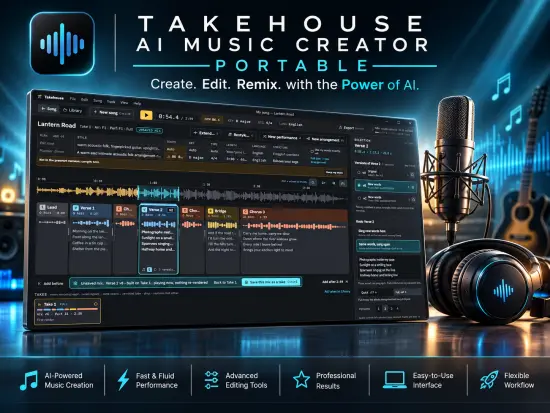
Takehouse AI Music Creator Portable is an innovative AI-powered music production application designed to make original song creation more accessible, flexible, and enjoyable. Combining artificial intelligence with a comprehensive song-editing environment, the software offers a practical solution for musicians, songwriters, composers, producers, and creative enthusiasts who want to transform musical ideas into complete songs.
Unlike many AI music generators that concentrate primarily on producing a finished audio track from a short text description, Takehouse introduces a more flexible approach to music creation. It treats the initial AI-generated song as the beginning of a creative process rather than the final result. Users can generate a complete musical composition, listen to the result, refine individual sections, experiment with alternative vocal performances, replace lyrics, extend arrangements, and create different versions without having to regenerate the entire song.
This approach makes Takehouse particularly interesting for anyone who wants more control over AI-generated music. Instead of accepting an entire composition exactly as the artificial intelligence produces it, users can work on specific elements and gradually develop a track that better matches their artistic intentions.
The application combines intelligent song planning, AI-powered instrumental generation, vocal synthesis, lyric management, arrangement editing, and audio exporting in a unified desktop workspace. Its interface provides access to the essential elements of a song while keeping the creative process organized and understandable.
Another important characteristic is its local processing architecture. The main music-generation models operate directly on the user’s computer using a supported NVIDIA graphics card. This means that the actual music-generation process does not depend on continuously uploading songs to an external cloud service.
Whether creating a completely original composition, experimenting with different musical styles, developing song ideas, or refining an existing arrangement, Takehouse AI Music Creator Portable provides an interesting environment for exploring the possibilities of artificial intelligence in modern music production.
AI Music Generation from Simple Text Descriptions
One of the main attractions of Takehouse AI Music Creator Portable is its ability to transform written descriptions into complete musical compositions.
Users can begin by describing the kind of song they want to create. A description might include a musical genre, desired atmosphere, instrumentation, vocal characteristics, emotional direction, or other creative details. Based on this information, the application’s AI-powered planning system prepares a musical concept that can subsequently be used to generate the composition.
This makes the software approachable even for people who do not have extensive experience with traditional music production tools. Rather than manually programming every instrument, arranging individual notes, or configuring complicated audio-processing parameters, users can communicate their creative intentions through natural language.
The planning process is an important part of the experience. Before generating the actual music, Takehouse presents a proposed arrangement containing relevant musical information such as tempo, key, time signature, and style interpretation.
This gives users an opportunity to examine the proposed musical direction before committing to the generation process. If the arrangement does not match their expectations, they can make adjustments and generate another plan.
The result is a more transparent workflow in which users have an opportunity to influence the musical foundation of their compositions.
Intelligent Song Planning and Arrangement Control
A particularly useful aspect of Takehouse is its separation between the initial song-planning stage and the actual music-generation process.
The application analyzes the user’s description and creates an organized musical plan. This plan includes the main characteristics of the intended composition and provides information about how the song should be structured.
Users can review the selected tempo, musical key, time signature, and interpretation of the requested style. The planner also displays its interpretation of the musical description, making it easier to understand how the original instructions have been translated into a production concept.
This additional level of transparency is valuable because AI-generated music does not always interpret creative descriptions exactly as expected. A user might request a warm acoustic folk arrangement, for example, while the planning system proposes additional instrumentation or a slightly different musical direction.
Being able to review the plan before rendering helps reduce unnecessary experimentation and gives users more control over the final musical character.
The software also includes a Style Check feature that identifies terminology or descriptions that the music-generation model might not understand. This helps users recognize potentially problematic instructions without automatically rewriting their original creative ideas.
The result is a workflow that encourages experimentation while keeping the user involved in important artistic decisions.
Complete Songs with Vocals and Musical Arrangements
Takehouse AI Music Creator Portable is designed to generate more than isolated musical fragments. Its primary workflow focuses on producing complete songs with instrumental arrangements and vocals.
This capability makes it suitable for developing song concepts, creating musical demonstrations, exploring different genres, and producing original compositions for personal creative projects.
The generated result can include a complete musical arrangement organized into recognizable song sections. Depending on the planned composition, these sections can include an introduction, verses, choruses, bridges, and other structural elements.
The application works with the song as an organized musical composition rather than presenting everything as one undifferentiated audio file.
This distinction becomes especially important during the editing process. When users decide that a particular verse needs improvement or that a chorus should sound different, they can work directly with the relevant section instead of starting over.
The ability to generate complete songs also provides a useful starting point for people who have musical ideas but lack the time, equipment, or technical knowledge required to create every part manually.
Flexible Lyrics Management and AI-Assisted Writing
Lyrics play an important role in songwriting, and Takehouse includes several tools designed to make working with written content easier.
Users can enter their own lyrics by typing or pasting text directly into the application. The software helps organize the material into recognizable song sections and can automatically tidy common formatting problems.
For example, section headings such as Verse 1, Chorus, or Bridge can be recognized and converted into appropriate structural tags. Stage directions and other non-lyrical instructions can also be separated from the actual words intended to be sung.
This is especially helpful when importing lyrics prepared in another writing application or copying material from an existing document.
Takehouse also provides optional AI-assisted lyric writing. Users can connect an online AI service using their own API key and select a compatible language model to help develop lyrics.
Alternatively, supported local language models can be used directly on the computer. This offers another possibility for users who prefer to keep their writing workflow local.
Importantly, AI-assisted writing is optional. Users who already have finished lyrics can simply provide their own words and concentrate on musical production.
The application supports song creation in English, Spanish, French, and Japanese, making it useful for a range of songwriting projects.
Section-Based Editing for Greater Creative Freedom
One of the most distinctive capabilities of Takehouse AI Music Creator Portable is its section-based editing system.
Traditional AI music-generation workflows can become frustrating when only a small part of a generated song needs improvement. Regenerating the entire composition may produce a better verse, but it can also change sections that were already satisfactory.
Takehouse approaches this problem differently.
Its song workspace organizes a composition into individual sections, allowing users to select a specific part and work on it independently.
For example, if the second verse contains lyrics that do not sound natural, users can select that verse and generate a replacement with new words. The rest of the song remains unchanged.
This is particularly useful when developing compositions that require repeated creative adjustments.
Users can concentrate on the chorus, experiment with alternative verses, improve a bridge, or explore different vocal performances without unnecessarily disturbing the remaining arrangement.
The ability to preserve the surrounding audio is an important advantage for maintaining continuity throughout the creative process.
Generate Alternative Vocal Performances and Song Versions
Not every musical section needs completely different lyrics to benefit from another generation.
Sometimes the words are already correct, but the vocal delivery, phrasing, or overall musical interpretation could be improved.
Takehouse provides an option to regenerate a selected section using the same lyrics while creating another performance.
This makes it possible to experiment with different interpretations without rewriting the entire passage.
Users can compare the available versions and select the one that best fits the composition.
Every regeneration becomes a separate version associated with its corresponding song section. These alternatives remain available within the project’s version-management system.
The software can maintain multiple variations of a section, making it easier to explore creative possibilities and avoid losing previously generated results.
Up to four variations can be created at a time, providing a useful range of alternatives when refining an important part of a composition.
Version Management and Intelligent Comping
Takehouse includes a version-management workflow that makes comparing and combining different creative results straightforward.
Whenever a user regenerates a song section, the new result is stored as another version. These versions are displayed together in the corresponding section of the song workspace.
Instead of forcing users to choose one complete regenerated composition, Takehouse allows them to select the preferred version of each individual section.
For example, a user might prefer the original first verse, the second version of the second verse, and the third version of the chorus.
These selections can be combined into a single musical arrangement immediately, without generating the entire song again.
This process is particularly valuable for songwriting because the strongest result is not necessarily the same version throughout the entire composition.
A particular vocal performance might work beautifully in one section, while another generated alternative might be more suitable for the chorus.
The ability to combine these results gives users greater flexibility when developing the final arrangement.
Once the preferred combination has been selected, it can be saved as a separate take. This preserves the chosen arrangement and provides another reference point for future creative work.
Reproduce Previous Takes with Exceptional Consistency
Reproducibility is another important feature that distinguishes Takehouse from simpler AI music-generation applications.
Every generated take is stored together with the information required to reproduce it. This includes the musical plan, generation seeds, model files, and relevant settings.
The Reproduce functionality uses this saved information to generate the same take again and compare the resulting audio with the original.
When the conditions match, the application can verify that the reproduced result is identical to the saved version, byte for byte.
This is particularly useful for users who value consistency and want to maintain a reliable record of their creative work.
In many AI-generation environments, recreating an earlier result can be difficult because the original settings or generation parameters may no longer be available.
Takehouse addresses this problem by treating each take as a reproducible recipe.
This approach also helps protect the continuity of longer projects. Users can keep their preferred versions, reproduce previous results when necessary, and maintain a more organized songwriting history.
Extend Songs Without Recreating the Original Composition
Sometimes a generated composition has the right atmosphere and arrangement but simply needs more musical development.
Takehouse includes an Extend function designed for this purpose.
Users can add up to one minute before or after an existing song. When extending the ending, they can also provide additional lyrics if they want the composition to continue with new vocal content.
The original musical material is preserved, allowing the new section to expand the composition without requiring the entire song to be regenerated.
This can be useful when a track needs a longer introduction, an additional musical passage, or a more developed ending.
The extension workflow provides another way to refine song structure while keeping previously generated material intact.
For musicians and composers experimenting with different arrangements, this can significantly simplify the process of developing a musical idea into a more complete composition.
Restyle Existing Songs and Explore New Musical Directions
Creative experimentation is an essential part of music production, and Takehouse includes a Restyle feature for exploring alternative musical interpretations.
Users can restyle an existing generated song or work with an imported recording to experiment with a different musical direction.
This makes it possible to explore how a composition might sound in another genre or arrangement style.
A musical idea initially developed as an acoustic folk song, for example, can become the starting point for a different stylistic interpretation.
Restyling provides an additional creative option without requiring users to abandon their original idea.
It can also be useful when developing alternative versions of a composition for different creative purposes.
Combined with section-based editing and version management, this feature helps turn AI music generation into a more exploratory production process.
Professional Audio Export and Flexible Output Settings
Once a composition has reached a satisfactory stage, Takehouse provides audio-export functionality for saving the finished result.
The application supports WAV and MP3 output, giving users flexibility when preparing music for different applications.
WAV export is available in 16-bit, 24-bit, and 32-bit floating-point formats. These options provide different output characteristics depending on the intended workflow.
The export system also includes loudness and peak-level controls.
Users can choose streaming loudness, peak-level settings, or an untouched export, depending on their preferences and the intended use of the recording.
This makes the application useful not only for generating musical ideas but also for preparing audio files that can be transferred into other production environments.
The ability to export standard audio formats makes it easier to continue working with a composition in an external digital audio workstation, audio editor, or other compatible application.
Local AI Processing and Privacy-Focused Music Production
One of the most significant aspects of Takehouse AI Music Creator Portable is its local processing architecture.
The AI models responsible for planning, playing, and singing the generated music run directly on the user’s supported NVIDIA graphics card.
Consequently, the main music-generation process does not require sending songs, lyrics, or musical projects to an external generation server.
The application does not require a Takehouse account or subscription to generate music, and its core generation workflow is designed to operate without an internet connection.
This approach provides several practical advantages.
First, users retain direct control over their musical projects and their stored files.
Second, they can create music without depending on the availability of an external generation service.
Third, the absence of mandatory cloud uploads provides a more private environment for experimenting with original compositions and unfinished creative ideas.
The software stores songs, lyrics, plans, takes, and regeneration versions locally. Users can also choose another storage folder through the application settings.
There are some optional online functions, particularly when users choose an external AI service for lyric writing. In that case, the information required for the lyric-writing request is sent to the selected provider under its own privacy terms.
Users who prefer a fully local lyric-writing workflow can instead choose a supported local language model.
This combination of local music generation and optional external writing services provides flexibility without making cloud-based processing a requirement for creating songs.
Takehouse and Takehouse Light Editions
Takehouse is available in two editions: Takehouse and Takehouse Light.
Both editions contain the models required for their respective music-generation workflows, meaning users do not need to download additional core music-generation models before creating songs.
The primary difference between the editions is the size of the planning model.
The standard Takehouse edition includes a larger 4B planner, while Takehouse Light uses a smaller and faster 1.7B planner.
Both editions include the Quick and Full generation options, the section finder, and the main creative features.
The standard edition requires approximately 12.2 GB of storage, while Takehouse Light requires approximately 10.4 GB.
This gives users the opportunity to select an edition according to their available storage and preferred planning-model configuration.
Regardless of the selected edition, the central philosophy remains the same: create a song, preserve every take, and continue improving individual sections without unnecessarily replacing the entire composition.
User Interface and Creative Workflow
The Takehouse interface is designed around a central song workspace that brings together the most important elements of the creative process.
The workspace includes the song timeline, waveform visualization, individual musical sections, version information, and editing controls.
Users can navigate between different parts of a composition and select the section they want to modify.
The timeline provides a visual overview of the song’s structure, making it easier to understand how verses, choruses, bridges, and other sections fit together.
When a section is selected, the corresponding editing panel provides access to its available versions and regeneration options.
The interface also includes controls for creating new songs, extending existing compositions, restyling musical material, and exporting finished recordings.
This integrated organization reduces the need to move between multiple unrelated applications during the initial songwriting and generation stages.
The workflow is particularly useful for users who prefer a visual overview of their projects rather than working exclusively with text prompts or isolated audio files.
System Requirements and Hardware Compatibility
Because Takehouse performs its main AI music-generation operations locally, compatible hardware is an important consideration.
The application is designed for 64-bit Windows computers running Windows 10 version 22H2 or later, or Windows 11.
A supported NVIDIA graphics card is required for music generation. Compatible hardware starts with the GeForce RTX 20 series and includes newer RTX generations.
The minimum recommended graphics memory is 8 GB, although 12 GB is recommended for a more comfortable experience.
An NVIDIA graphics driver version 525 or newer is also required.
The application recommends 16 GB of system RAM.
Storage requirements depend on the selected edition, with approximately 12.2 GB needed for the standard edition and 10.4 GB for Takehouse Light. Additional storage should be available for generated songs and their versions.
Since every take is preserved at full quality, storage consumption should also be considered when working on multiple compositions.
The application uses approximately 23 MB per minute for each saved take, while a regenerated section stores only the audio associated with the changed part.
These requirements make Takehouse particularly suitable for users who already own a reasonably modern NVIDIA-based desktop or laptop.
Who Can Benefit from Takehouse AI Music Creator Portable?
Takehouse is designed for a broad range of creative users.
Songwriters and lyricists can use the application to transform written ideas into complete musical compositions, experiment with vocal performances, and refine individual sections.
Independent musicians can explore different genres, generate song demonstrations, and experiment with alternative arrangements without having to build every element manually.
Music producers can use AI-generated compositions as starting points for further production, export audio files, and continue refining their projects in compatible external software.
Creative enthusiasts can explore songwriting and music generation through natural-language descriptions without needing extensive technical knowledge.
Composers and experimental artists can benefit from the ability to compare different versions, preserve successful takes, and explore alternative musical directions.
Content creators can develop original musical concepts for creative projects, provided they review the relevant licensing terms and intended usage requirements before distributing generated material.
The application is particularly interesting for people who want to participate actively in the development of AI-generated music rather than simply requesting a track and accepting whatever result appears.
A Different Approach to AI-Assisted Music Production
Takehouse AI Music Creator Portable demonstrates an interesting direction for AI-assisted music production.
Its strongest concept is the idea that music generation should not end when the first composition has been rendered.
Instead, the generated song becomes an editable creative project that can evolve through experimentation, comparison, and selective regeneration.
The ability to change individual verses, generate alternative vocal performances, combine preferred versions, extend compositions, and restyle existing material creates a more flexible environment than a workflow based exclusively on complete-song regeneration.
The reproducibility system adds another valuable dimension by preserving the information associated with each take.
Its local processing architecture also makes the application particularly appealing to users who prefer to keep their music projects on their own computers.
Although suitable NVIDIA hardware is essential, the combination of local AI generation, structured editing, version management, and standard audio export provides a compelling set of tools for independent music creation.
For anyone interested in exploring artificial intelligence as part of the songwriting process, Takehouse offers an environment where creative experimentation and practical control can work together.
Rather than treating artificial intelligence as a replacement for artistic decisions, the software positions it as a tool that can help transform initial ideas into musical compositions and provide opportunities for further refinement.
With its integrated generation and editing workflow, Takehouse AI Music Creator Portable is a noteworthy option for musicians, songwriters, producers, and enthusiasts looking for a more interactive approach to AI-powered music creation.
Features at a Glance
- AI-Powered Music Generation: Transform written descriptions into complete musical compositions with instrumental arrangements and vocals.
- Intelligent Song Planning: Automatically prepare musical plans with tempo, key, time signature, and style interpretation.
- Local AI Processing: Generate music directly on a compatible NVIDIA graphics card.
- Complete Song Creation: Produce structured compositions containing verses, choruses, bridges, and other sections.
- Custom Lyrics: Write, paste, organize, and manage original lyrics.
- AI-Assisted Lyric Writing: Connect compatible online AI services using your own API key or use supported local language models.
- Automatic Lyric Formatting: Recognize song-section headings and organize pasted lyrics.
- Section-Based Editing: Regenerate individual song sections without replacing the entire composition.
- New Lyrics Generation: Replace the words of a selected section and generate another performance.
- Alternative Vocal Performances: Keep existing lyrics while generating another interpretation.
- Multiple Section Versions: Maintain and compare up to four variations of a section.
- Intelligent Version Comping: Combine preferred versions of different sections without another complete generation.
- Save Custom Takes: Preserve selected combinations as independent takes.
- Reproduce Function: Recreate previous takes using their saved generation information and verify identical results.
- Song Extension: Add up to one minute before or after an existing composition.
- Restyle Function: Explore different musical styles using generated songs or imported recordings.
- Quick and Full Generation: Choose between two available generation workflows.
- Section Finder: Work with the song’s individual structural sections.
- Waveform Visualization: Navigate the composition through its visual audio timeline.
- WAV Export: Save audio in 16-bit, 24-bit, or 32-bit floating-point format.
- MP3 Export: Create compressed audio files for convenient playback and distribution.
- Loudness Controls: Choose streaming loudness, peak-level settings, or untouched output.
- Multiple Languages: Create songs in English, Spanish, French, and Japanese.
- Two Editions: Choose between Takehouse and Takehouse Light.
- Local Project Storage: Keep lyrics, plans, takes, and song versions on your computer.
- No Mandatory Account: Create music without registering for a Takehouse account.
- No Music-Generation Subscription: The core local music-generation workflow does not require a Takehouse subscription.
- Offline Music Creation: Generate songs without a continuous internet connection.
- Privacy-Focused Architecture: Keep the main music-generation process and projects on your own computer.