Portable Donemax Data Eraser Business 5.0
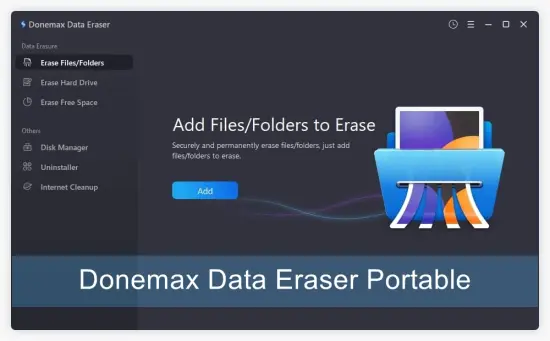
Donemax Data Eraser Business Portable is a data-erasure utility intended for organizations and professionals who need to remove information from computers and storage devices before reusing, transferring, donating, selling, or retiring them. Instead of treating deletion as a simple move to the Recycle Bin, the software provides purpose-built options for erasing selected files, wiping a drive, or clearing unused disk space that may still contain remnants of previously deleted data.
For a business, this kind of tool can fit into everyday equipment handling: preparing a computer for another employee, clearing an external drive before it leaves the office, or sanitizing storage ahead of recycling. Its central purpose is straightforward—help users make chosen information much harder to recover through ordinary data-recovery methods. The three primary erasure modes are designed for different situations, allowing the operator to choose between targeted cleanup and a broader wipe.
What Donemax Data Eraser Business Portable Is Designed to Do
Deleting a file in the usual way does not necessarily overwrite the information stored on a disk. In many cases, the operating system removes the file’s reference from its directory and marks the space as available for reuse. Until that space is overwritten, recovery software may be able to reconstruct some or all of the deleted content.
Donemax Data Eraser Business Portable addresses this gap by offering secure-erasure operations for selected files and folders, entire drives, and unused disk space. The product is presented for business and enterprise use, including workflows involving computers and external storage. Supported device categories include hard drives, solid-state drives, USB storage, memory cards, digital cameras, and other connected storage media, subject to compatibility with the system and the specific device.
The “Portable” suffix here describes the requested product name; it should not be taken as confirmation that the software can be run without installation or from a USB stick. Check the vendor’s current packaging and licensing details if portable deployment, unattended operation, or use across a fleet of computers is essential to your workflow.
Three Ways to Erase Data
The software’s main strength is that it separates erasure into three practical modes. That distinction helps users avoid wiping more than intended while still providing an option for broad device preparation.
Erase Files and Folders
The file-erasure mode is for information that needs to be removed selectively. An operator chooses specific files or folders, reviews the selection, and starts the erase operation. This can suit an organization that wants to securely remove a particular set of records from a machine while keeping unrelated work files in place.
Typical examples might include clearing a folder of temporary exports, removing old project materials from a shared workstation, or deleting confidential documents from an external drive before it is reassigned. The value of a selective mode is control: it narrows the scope of the operation compared with wiping a whole disk.
That control also makes careful review important. Before starting, check the selected paths and filenames, especially if folders contain nested content. Secure erasure is meant to make the chosen data unrecoverable, so a mistaken selection can have consequences beyond ordinary deletion. Maintain a backup of anything that may still be needed.
Erase a Hard Drive
The drive-erasure mode targets the contents of a selected drive. This is the broadest option and is suited to preparing a storage device for a new owner or a different role. For example, an IT team might use it when a computer is being decommissioned, a drive is being reused in another system, or a storage device is leaving the organization.
A full-drive wipe can take longer than deleting a few files, with the duration depending on the device, its capacity, its connection type, and the selected method. The operator should identify the target drive by its label, capacity, and other visible details before proceeding. If more than one external drive is connected, disconnect any that are not part of the task to reduce the chance of choosing the wrong one.
A key operational distinction is the system disk. Product documentation indicates that the Windows edition does not directly erase operating-system files in the active system drive; wiping a system disk may require connecting it to another computer as a secondary drive. This matters when planning workstation retirement: do not assume that launching the utility on a computer lets you erase the operating system drive from underneath itself.
Erase Free Space
Free-space erasure is intended for a different situation: the drive is staying in use, but the user wants to overwrite space that may hold traces of files deleted in the past. The operation targets unused space rather than existing files, so it can be used to reduce the recoverability of previously deleted data without intentionally clearing the files currently stored on the drive.
This option can be useful after routine deletion of sensitive information, or when a device will remain with the organization but needs a more thorough cleanup. It is not the same as a complete drive wipe. Existing data should still be backed up, and the selected disk should be checked carefully before running the task.
Erasure Methods and Passes
The product describes multiple erasure algorithms, including named methods associated with standards or established overwrite patterns. Examples listed in product information include HMG Infosec Standard 5, U.S. Army AR380-19, DoD 5220.22-M ECE, and Peter Gutmann algorithms. These options differ in their overwrite patterns and number of passes.
In general, more passes mean more write activity and often a longer operation. A higher pass count is not automatically the best choice in every case: the right method depends on your organization’s policy, the storage technology, and the applicable requirements. For routine equipment turnover, an established policy and consistent procedure can be more useful than choosing the maximum number of passes without considering practical needs.
Organizations handling regulated or contractually controlled information should verify whether a particular erasure method satisfies their own requirements. A software feature list alone does not establish compliance with every law, industry rule, customer contract, or internal security standard. Record the method selected and the device processed as part of a controlled asset-disposal workflow where documentation is needed.
Supported Storage and Business Scenarios
Donemax Data Eraser Business Portable is aimed at workflows where data may reside on more than a computer’s internal disk. Product materials list support for HDDs, SSDs, USB drives, memory cards, digital cameras, and other external storage devices. The practical requirement is that the device must be visible and accessible to the computer running the application.
That range can help organizations manage small, mixed collections of equipment. A business may have desktop computers, laptops, portable hard drives, removable flash drives, or memory cards used with cameras and field equipment. Having file, drive, and free-space operations in one utility can make the workflow easier to standardize.
The software is described as a Windows product, with the vendor also offering a separate Mac edition. The Windows edition’s listed compatibility includes Windows 11, 10, 8, 7, Vista, and Windows Server versions, though businesses should confirm support for their exact operating-system edition and configuration before deployment. The Mac software is a separate product rather than an assumption that one installer works across both platforms.
A Simple Workflow for Preparing a Device
A safe, repeatable process is just as important as the erasure utility itself. A practical sequence for using Donemax Data Eraser Business Portable could look like this:
- Confirm the device’s destination. Determine whether it will be reused internally, transferred to another party, sold, donated, or recycled.
- Back up required information. Secure erasure is intended to prevent recovery, so copy any records that must be retained before starting.
- Identify the correct storage device. Check its label, capacity, and connection. Disconnect unrelated removable storage where possible.
- Choose the appropriate mode. Use file erasure for selected items, drive erasure for a full-device clear, or free-space erasure when existing files should remain.
- Review the target and method. Confirm that the selection is correct and that the chosen erasure approach matches organizational policy.
- Run the operation and wait for completion. Avoid unplugging a device or shutting down the computer while an erase task is in progress.
- Record the result. For business asset handling, note the device identifier, operator, date, selected mode, and completion status according to internal procedures.
The user guide describes a direct workflow for file erasure: choose the mode, add the files or folders, confirm the selection, choose an erasure standard, and proceed. It also describes checking the erasure history in the application, with options to export or delete that history.
Erasure History and Operational Oversight
For individual users, a completed task may be enough. For a business, it is often useful to maintain a record of what happened to an asset. Donemax Data Eraser includes an erasure-history view, and the guide indicates that users can export or delete the recorded history.
This can help an administrator check whether an operation completed and support a broader equipment-disposal process. A software history should not automatically be treated as a complete audit system, however. An organization may need to preserve additional records, such as an inventory tag, serial number, assigned employee, approval, chain-of-custody information, or a handoff receipt. Set a retention policy that determines which records are kept and who can access them.
A consistent checklist can reduce errors across a team. It can also make the process easier to repeat when different employees handle device returns or equipment refreshes. The software supplies the erasure functions; the organization’s procedures determine how those functions are used and documented.
Additional Utilities
Product documentation also describes extra tools alongside erasure. These include disk tools for functions such as formatting, renaming, or attempting to repair a damaged disk; an uninstaller for removing programs and associated leftovers; and an internet-cleaning feature for clearing browser cookies, caches, histories, and related traces.
These utilities broaden the application beyond one-time disposal. For example, a technician might use the browser-cleaning option as part of a workstation cleanup or the uninstaller when removing unwanted software. They are separate from secure drive erasure and should be treated accordingly: clearing browser data is not the same as wiping an entire disk, and formatting alone should not be assumed to provide secure, unrecoverable deletion.
For a business rollout, decide which supplementary functions are in scope. If the goal is strictly secure media sanitization, a narrow procedure may be preferable. If the tool will also be used for routine cleanup, define permissions and training so that users understand which actions are destructive and which are maintenance tasks.
What to Consider Before Using It
Secure erasure is deliberately different from ordinary cleanup: it is intended to make data unavailable for recovery. That makes preparation essential. The most important precaution is confirming that the selected files or drive are the intended target. Back up necessary records first, and do not rely on the eraser as a substitute for a data-retention plan.
Another consideration is the storage technology. HDDs and SSDs operate differently, and the way data is managed internally can vary by device and configuration. Product materials state that the software is designed to erase supported storage without physical damage, but users should still review the vendor’s guidance for their specific hardware and intended outcome.
Also consider whether the computer can erase the drive you have selected. An actively running system disk may require a different procedure from a removable data disk. For large deployments, test the planned workflow on noncritical equipment first, confirm the supported operating systems, and document the steps technicians should follow.
Finally, verify product naming, licensing, and deployment terms directly with the vendor before purchasing or installing it across an organization. The available product information distinguishes standard and enterprise editions, with enterprise licensing described as supporting unlimited PCs. The exact edition, permitted use, and licensing terms may depend on the current offering.
Who May Find Donemax Data Eraser Business Portable Useful?
The software may be relevant to small businesses, IT service providers, schools, offices, and other organizations that regularly reassign, donate, sell, or recycle computers and storage media. Its three main modes offer a straightforward division of work: erase selected items, wipe a device, or clear unused disk space while retaining current files.
It may also suit technicians who need a desktop utility for occasional cleanup tasks across different kinds of storage. The business value comes less from any single button than from making secure erasure a planned step in asset management. With backups, device identification, staff training, and documentation in place, a dedicated erasure tool can help make turnover procedures more deliberate and repeatable.
Overall Assessment
Donemax Data Eraser Business Portable is best understood as a focused data-erasure application with additional cleanup utilities. Its primary workflow centers on selective file deletion, whole-drive wiping, and free-space erasure. The inclusion of several named overwrite methods provides choices for different operating procedures, while the erasure-history feature can support basic tracking.
The main strengths are its clear separation of tasks, support for a range of storage-device types, and a workflow that does not require users to work from command-line tools. The main cautions are the irreversible nature of secure erasure, the need to verify the target carefully, and the importance of confirming how the active operating-system disk can be handled. Businesses should also validate their licensing and compliance needs rather than assuming a software feature automatically meets every policy requirement.
Used thoughtfully, Donemax Data Eraser Business Portable can form one part of a responsible device-retirement or data-cleanup process. It is not a replacement for backups, asset management, retention rules, or a company’s security policy, but its distinct erasure modes give administrators practical options for common device-handling scenarios.
Features at a Glance
- Erase files and folders: Select specific items for secure deletion.
- Wipe a hard drive: Clear a selected drive before reuse, transfer, donation, sale, or disposal.
- Erase free space: Target unused disk space that may contain traces of previously deleted data.
- Multiple erasure methods: Includes named algorithms and overwrite patterns described in product materials.
- Broad storage support: Designed for HDDs, SSDs, USB drives, memory cards, cameras, and other connected storage.
- Erasure history: Review operations and export or delete the history.
- Additional utilities: Includes disk tools, an uninstaller, and browser-cleaning functions.
- Business-oriented licensing: An enterprise edition is described as supporting unlimited PCs; confirm current terms with the vendor.
- Windows availability: Windows editions are listed for Windows 11, 10, 8, 7, Vista, and Windows Server.
- Important operational note: Back up needed files and carefully verify targets before erasure, because secure deletion is intended to prevent recovery.